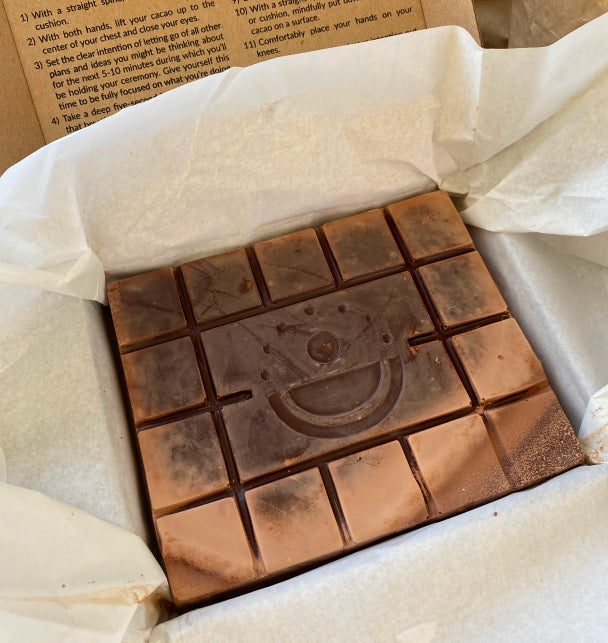
You open your box of cacao and instead of the silky brown chocolatey goodness you expect, it looks a little... well, mouldy? Gone off?
Wait. Before you panic that a) you won't be able to make your morning cacao (and trust us, you don't want to see us without our morning cacao) or b) that's money down the drain, let us explain a bit about cacao blooming.
What is bloom?
Bloom is the whitish-grey streaks, spots or dusty film that can appear on the surface of cacao and chocolate. It isn't mould, and it doesn't mean your cacao has spoiled. There are two kinds.
Fat bloom
Cacao paste is roughly half cacao butter. When cacao warms up and then cools again, some of that butter melts, rises to the surface and re-sets in a different crystal form. The result is soft, greyish streaks or a marbled look. This is the most common type of bloom, and in a warm Australian summer it can happen quickly, even on the trip from the post box to your kitchen.
Sugar bloom
Sugar bloom happens to sweetened chocolate when moisture (often condensation after being in the fridge) dissolves a little sugar on the surface, which then dries into a fine, dry, white dust. Pure cacao paste has no added sugar, so it usually only shows fat bloom.
Is bloomed cacao safe?
Yes. Bloom is a physical change in the cacao butter, not spoilage. The flavour and goodness are the same. Once you melt bloomed cacao into a warm drink, the butter re-melts and you won't be able to tell the difference.
How to tell bloom from mould
- Bloom is flat, smooth or dusty, and greyish-white. It melts away if you rub it with a warm finger, and your cacao smells like cacao.
- Mould is fuzzy or raised, often green, blue or black, and smells musty. Cacao paste is very dry, so mould is rare, but if you see it, don't use it.
How to prevent bloom
- Store cacao in a cool, dry, dark cupboard, ideally below about 20°C.
- Keep it in an airtight container, away from strong smells.
- Avoid big temperature swings. The fridge isn't ideal, as condensation forms when you take it out.
- In very hot weather, keep it in the coolest part of the house rather than near the stove or a sunny window.
So if your cacao arrives a little dusty or marbled, don't throw it out. Melt it, whisk it and enjoy. Browse our ancestral cacao range.


